3. Dynamic Granule object management
RMM needs metadata to record how physical memory is being used. Keeping a
separate struct granule for every 4 KiB page can require a large amount
of memory. Tracking regions let RMM use one struct granule for a whole
region when possible, and separate granules for its pages when needed.
This guide starts with that choice, then explains where the metadata lives, how RMM changes the tracking mode safely, and how range commands use it. Most examples use a 2 MiB region containing 512 Granules of 4 KiB each. Examples using 1 GiB regions say so explicitly.
For the wider memory design, see MMU setup and memory management design in RMM. The full lock ordering rules are in RMM Locking Guidelines, and the RTT range-command flows are in RTT map/unmap flows.
3.1. Tracking model
3.1.1. Terminology
An RMI Granule is a 4 KiB unit of physical memory. A struct granule
records the state, lock and reference count for conventional memory.
Device memory uses struct dev_granule. Either object can track one
physical Granule or a whole tracking region.
The names struct granule and struct dev_granule refer to these
bookkeeping objects; physical Granule refers to the 4 KiB memory unit.
Tracking size is the amount of physical memory represented by one object,
not its size in bytes. Rules stated for granules apply to both structs unless
a memory category is specified.
A tracking region is a fixed-size range of physical addresses (PAs). The
Host selects 2 MiB or 1 GiB regions with RMI_RMM_CONFIG_SET before
activation. Each region starts at an address aligned to that size.
If a region contains any platform memory, RMM gives it a
struct tracking_region. This C object stores the region’s tracking state,
memory category, transition marker, reader-writer lock and coarse granule.
Together, the struct tracking_region array and the fine granule arrays
form the tracking metadata. Each region can use either:
one coarse granule for the complete tracking region; or
one fine granule for each 4 KiB position in the tracking region.
For example, consider the 2 MiB region starting at 0x80000000:
Physical memory:  [ G0 ][ G1 ][ G2 ] ... [ G511 ]
                    Each Granule is 4 KiB

COARSE tracking:  [ one struct granule covers all 512 physical Granules ]
FINE tracking:    [ F0 ][ F1 ][ F2 ] ... [ F511 ]
                    One struct granule per physical Granule
With coarse tracking, the whole region has one state, such as DELEGATED.
With fine tracking, G0 can be DELEGATED while G1 is NS.
The physical region stays the same size when its tracking mode changes.
These are two different kinds of state: FINE and COARSE describe
how memory is tracked; NS, DELEGATED and DATA describe
how that memory is used. For example, a region can be COARSE with its
single granule in DELEGATED state. See MMU setup and memory management design in RMM for
the Granule states.
Both coherent and non-coherent device memory use dev_granules. Device
lookups also return the coherency type, so using the same struct type does
not lose that distinction. The struct tracking_region object records
which coarse or fine representation is active.
The tracking state has the following meaning:
State |
Active representation |
Meaning |
|---|---|---|
|
None |
The queried PA range is not covered by any platform memory bank. |
|
None |
A represented region currently has no usable granule structs. |
|
Fine granule arrays |
Each valid 4 KiB Granule has an independently managed granule. |
|
Granule in |
One granule represents the complete tracking region. |
For example, NONE can describe a region of real memory that has not yet
been given granules. RESERVED describes a hole in the platform memory
map. Allocating granules cannot turn a hole into usable memory.
A homogeneous region is fully covered by one memory category. A diverse
region contains a hole or more than one category; the implementation calls
this composition mc_diverse. That name is internal, not an RMI category.
For example, a region with 1 MiB of conventional memory and 1 MiB of device
memory is diverse. It cannot use one coarse granule for both halves.
It must use FINE tracking or remain NONE.
3.1.2. Tracking metadata layout
The platform describes its memory as banks: address ranges with a memory
category. It supplies separate struct plat_memory_bank arrays for
conventional, coherent-device and non-coherent-device memory. RMM copies
these into struct tracking_memory_bank arrays, combining the device banks
and retaining each bank’s category. It sorts the arrays by PA and checks that
their ranges do not overlap.
Each struct tracking_memory_bank stores the bank’s PA range, memory
category and starting indices in the struct tracking_region and fine
granule arrays. The term memory bank refers to the physical address range
described by the structure.
tracking_regions[] contains one struct tracking_region for each region
that contains any memory, in PA order. Whole regions with no memory take no
array space. Two banks within the same region share one
struct tracking_region.
For example, this layout needs only two entries:
2 MiB physical regions              tracking_regions[]

0x80000000  [ conventional bank A ]  -> [0]
0x80200000  [        hole         ]     no entry
0x80400000  [ bank B  |  bank C   ]  -> [1] shared by B and C
0x80600000  end

Bank B: conventional, 0x80400000 to 0x80500000
Bank C: device,       0x80500000 to 0x80600000
Fine granules live in two separate arrays:
granule_array_trcontains finegranulesfor conventional memory; anddev_granule_array_trcontains finedev_granulesfor both device categories.
These arrays also omit whole-region holes. Within a represented region,
however, each applicable array reserves a slot for every 4 KiB position.
In the example, region [1] has 512 conventional slots and 512 device
slots. Only the conventional slots for bank B and the device slots for bank C
correspond to valid memory. This leaves a simple calculation from a PA to
its slot, even when banks share a region.
Each region’s fine-granule storage starts and ends on a page boundary, with padding where needed. A metadata page therefore belongs to just one region, so RMM can reclaim it without removing another region’s granules. Reserving these array positions does not itself allocate physical memory; the allocation modes mentioned later below determine when pages are supplied.
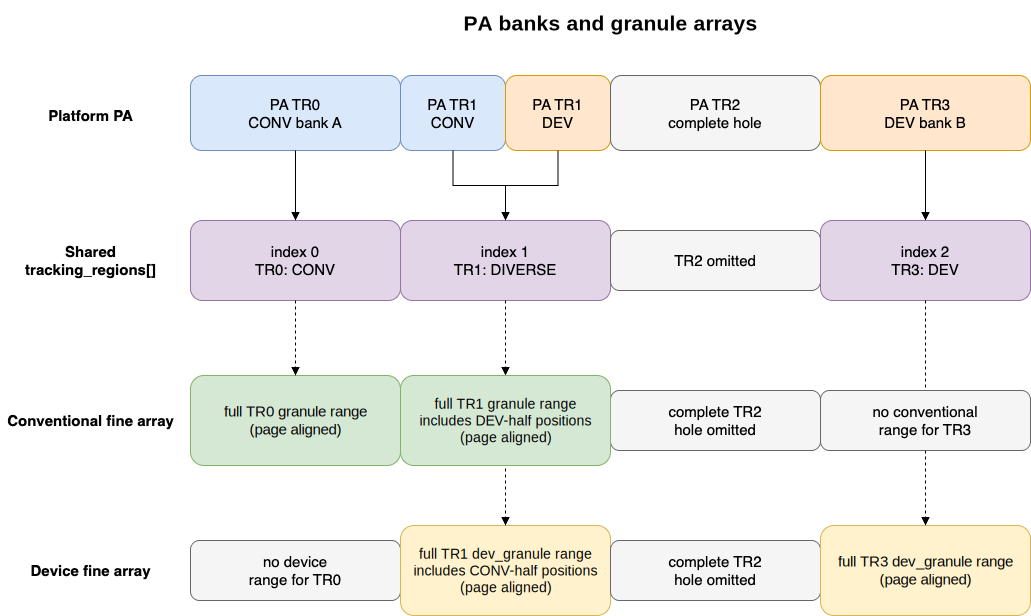
Platform PA banks map into a shared struct tracking_region array and
separate fine granule and dev_granule arrays.
To find a granule from a PA, RMM first binary-searches the appropriate
struct tracking_memory_bank array. The matching structure’s
tracking_start_idx and granule_start_idx identify its starting entries
in tracking_regions[] and the fine granule array. RMM then calculates
the region and Granule offsets.
The reverse lookup checks that an array slot belongs to real memory in a
bank. Slots for holes or padding have no valid PA.
3.1.3. struct tracking_region
struct tracking_region contains:
a union holding either a coarse
granuleor a coarsedev_granule;a reader-writer lock protecting the choice of coarse or fine tracking; and
a compact field containing the tracking state, memory composition and a bit indicating that a tracking change is in progress.
Only the selected representation is active. For example, when changing from
coarse to fine, RMM prepares the fine granules while holding the region’s
write lock. It then publishes FINE, making those granules active.
The old coarse granule becomes inactive. Runtime callers must always use
the active representation; the locking protocol is explained below.
3.2. Initialization and memory
3.2.1. Boot-time setup
Early in cold boot, glob_data_init() allocates 8 KiB for one
struct tracking_region_data through rmm_el3_ifc_reserve_memory().
This API normally requests memory from EL3 using SMC_RMM_RESERVE_MEMORY;
with RMM_EL3_COMPAT_RESERVE_MEM, it uses the platform reservation callback.
The allocation is mapped into RMM, and its PA, VA and size are recorded in
struct glob_data.
The first 4 KiB contains the embedded struct tracking_memory_bank arrays:
64 conventional-memory entries and 64 device-memory entries, populated from
the platform banks. The second 4 KiB contains the configured region size,
counts, initialization flag, a pointer to the struct tracking_region array,
and three array-mapping records containing VA, size and mapping state. The
remaining space is alignment padding. The struct tracking_region and fine
granule arrays have separate backing allocations.
struct tracking_region_data survives Live Firmware Activation (LFA),
which replaces the running firmware image.
Before the Host selects a region size, RMM calculates how much array space each supported size needs. It reserves virtual address (VA) ranges in its low VA space, large enough for either layout, for:
the
struct tracking_regionarray,tracking_regions[];the fine
granulearray; andthe fine
dev_granulearray.
Configuration calculates the indices in each struct tracking_memory_bank
for the chosen size within those fixed reservations. During LFA,
glob_data_init() checks the version field in struct glob_data,
and the new image reuses the existing indices, mappings and granule state.
3.2.2. Activation modes
The permanent struct tracking_region array, tracking_regions[], always
uses EL3-private memory, allocated during cold boot for the largest supported
layout and retained across LFA. This memory is reserved outside Host-managed
memory; it needs no struct granule of its own. Activation therefore cannot
introduce a recursive need for fine metadata to describe Host-donated backing
for struct tracking_region.
RMM_ALLOC_TRACKING_DATA selects how the fine granule arrays are backed:
Configuration |
How metadata memory is supplied |
Initial tracking state |
Later transitions |
|---|---|---|---|
Enabled |
EL3 supplies all reserved array storage at boot. Activation initializes the selected layout. |
Every represented region finishes activation as |
No metadata donation or reclaim is needed. |
Disabled |
EL3 supplies the |
Homogeneous regions start |
|
With the option enabled, all metadata memory must be available at boot; failure to allocate it is a boot failure. Either supported region size can then be selected without further allocation.
With the option disabled, only the permanent struct tracking_region array
must be available at boot; failure to allocate it is a boot failure. The Host
supplies pages backing the fine granule arrays as regions need them. For
example, an unused homogeneous region can start COARSE.
When the Host needs to manage one of its 512 pages separately, it requests
FINE tracking and supplies metadata memory. If the region later meets
the conditions for COARSE again, the Host can reclaim that memory.
3.2.3. SRO donation and reclaim
A Stateful RMI Operation (SRO) lets one operation span several Host calls. RMM saves its progress and returns a handle. The Host uses that handle to continue the operation, donate requested memory or reclaim returned memory, as directed by the response. Here, donation means supplying pages for RMM to use as metadata; reclaim means getting those pages back.
Activation completes synchronously in both allocation modes:
Atomically change the global RMM state from
INITtoINTERMEDIATE. Configuration changes and a second activation are rejected during setup.Initialize
tracking_regions[]using its existing EL3-private backing. With preallocated fine arrays, every region startsFINE. Otherwise, homogeneous regions startCOARSEand diverse regions startNONE.Publish the global state
ACTIVEand returnRMI_SUCCESS.
Activation does not reserve an SRO or request Host memory. The temporary global
INTERMEDIATE state serializes initialization; it is separate from the
unimplemented tracking state of the same name.
For a later change from COARSE to FINE, the sequence is:
Validate the source region and mark the tracking change as pending.
Request pages for its conventional and/or device fine arrays, depending on which memory types the region contains.
Validate and map the donated pages at the reserved VAs, in donation order.
Initialize the fine granules and publish
FINEbefore finishing the SRO and clearing the pending marker.
When leaving FINE, the order is reversed in one important respect:
RMM first switches to COARSE or NONE, then unmaps and returns the
now-unused fine metadata. The marker remains set until reclaim finishes.
In this allocation mode, entering or leaving FINE always transfers at
least one page; a completed transition leaves no unused fine backing behind.
3.2.3.1. Where donated pages come from
Usually, a metadata page comes from another region and already has a fine
granule. It must be delegated conventional memory. Its granule changes
from DELEGATED to INTERNAL while RMM uses the page, and back to
DELEGATED on reclaim.
A page donated from the target region is self-describing: it helps store the fine metadata for the region that contains it. Its own fine granule is only available after the new metadata is installed. This requires a special rule for its donation state:
Current representation |
Required donation state |
How RMM accepts the page |
|---|---|---|
|
|
Ask EL3 to move the page into Realm Physical Address Space (PAS). |
|
|
Ask EL3 to move the page into Realm PAS. |
|
|
The page is already in Realm PAS. |
For example, suppose region A is COARSE and NS. The Host donates
page P from A to help create A’s fine granules. RMM first delegates
P through EL3. Once all metadata is installed, ordinary pages have fine
granules in NS state, while P has a granule in INTERNAL
state because RMM is using it.
On rollback or reclaim, the remaining representation determines how to
return a self-describing page. An NS or untracked page is undelegated
through EL3 and returned as UNDELEGATED. A page covered by a delegated
coarse granule stays DELEGATED. This exception applies only to pages
in the target region; it does not allow an untracked page elsewhere to be
donated as ordinary metadata.
A metadata page’s PA does not determine the lock order of the granules stored in it. The order follows the represented memory’s PA, regardless of where the Host placed the metadata.
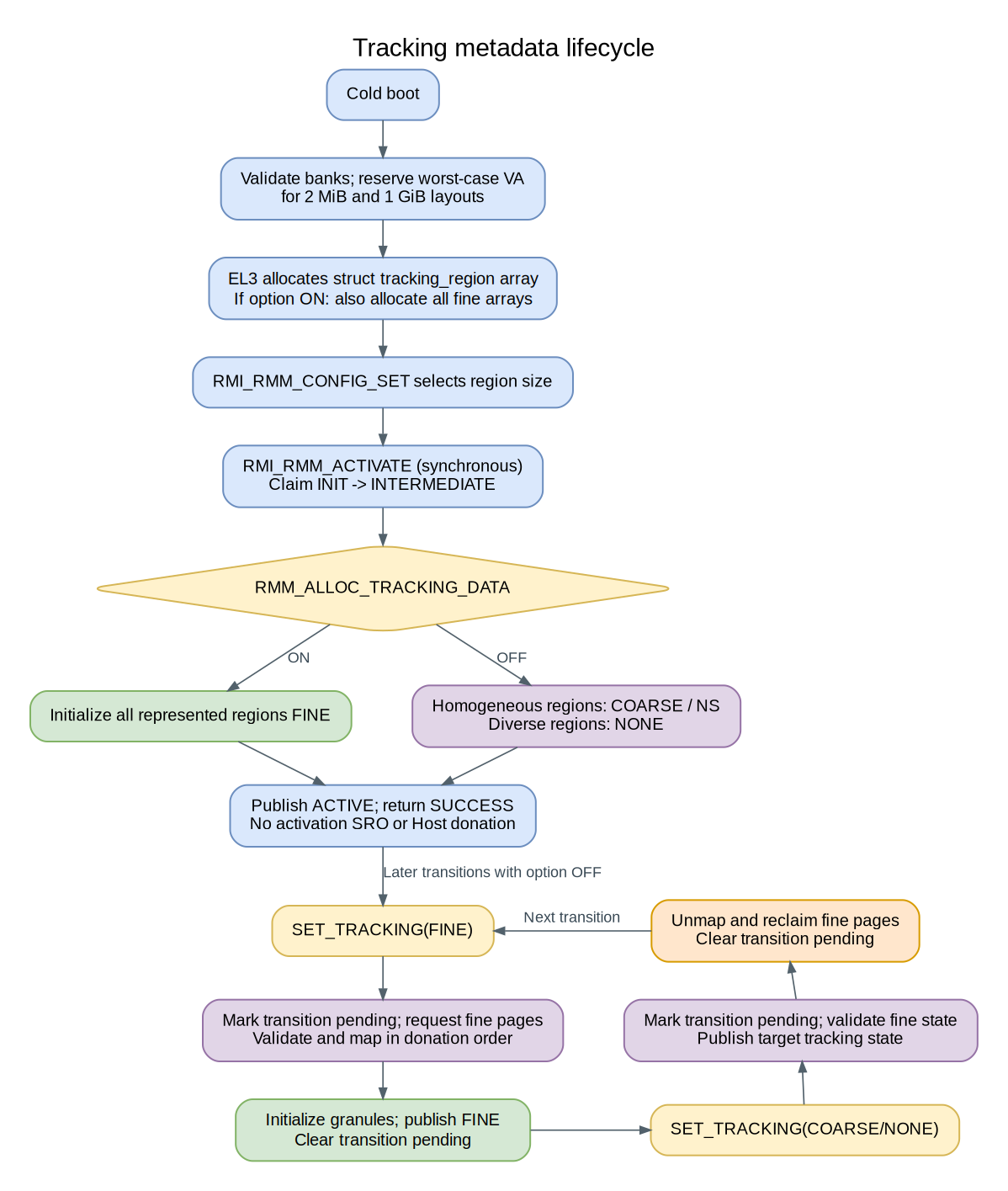
Tracking metadata lifecycle for EL3 allocation and Host SRO donation.
3.2.3.2. SET_TRACKING with a nested EL3 operation
Moving a metadata page between Non-secure and Realm PAS can itself take several EL3 calls. There are then two operations to keep track of:
The outer
RMI_GRANULE_TRACKING_SEToperation, called SET_TRACKING below, owns the region and metadata transfer. The Host knows it by handleH.The inner EL3 operation changes a page’s PAS. RMM knows it by a private continuation cookie
Creturned by EL3.
For example, EL3 may finish delegating page P while SET_TRACKING still
needs to initialize the fine granules. Cookie C is then finished,
but handle H remains live until the outer operation also finishes.
The Host always uses H; it never sees or submits C.
Both operations’ progress is saved in the same RMM SRO context, in
sro_tracking_ctx. No second SRO handle is needed, and SET_TRACKING does
not call the RMI range-delegation or range-undelegation handlers.
It cannot be cancelled. Its pending marker excludes other region users until
it finishes, but Granule locks are released before each return to the Host.
The shared helper rmm_el3_ifc_gtsi_step() manages the EL3 progress. It is
also used by range delegation, undelegation and delegation rollback. A valid
cookie means resume with GPI_OP_CONTINUE; otherwise the helper starts a
GPI_SET for the remaining range. Each invocation issues at most one
request through the FIRME interface to EL3. The caller still handles memory
sanitization, tracking-state updates and progress reports to the Host.
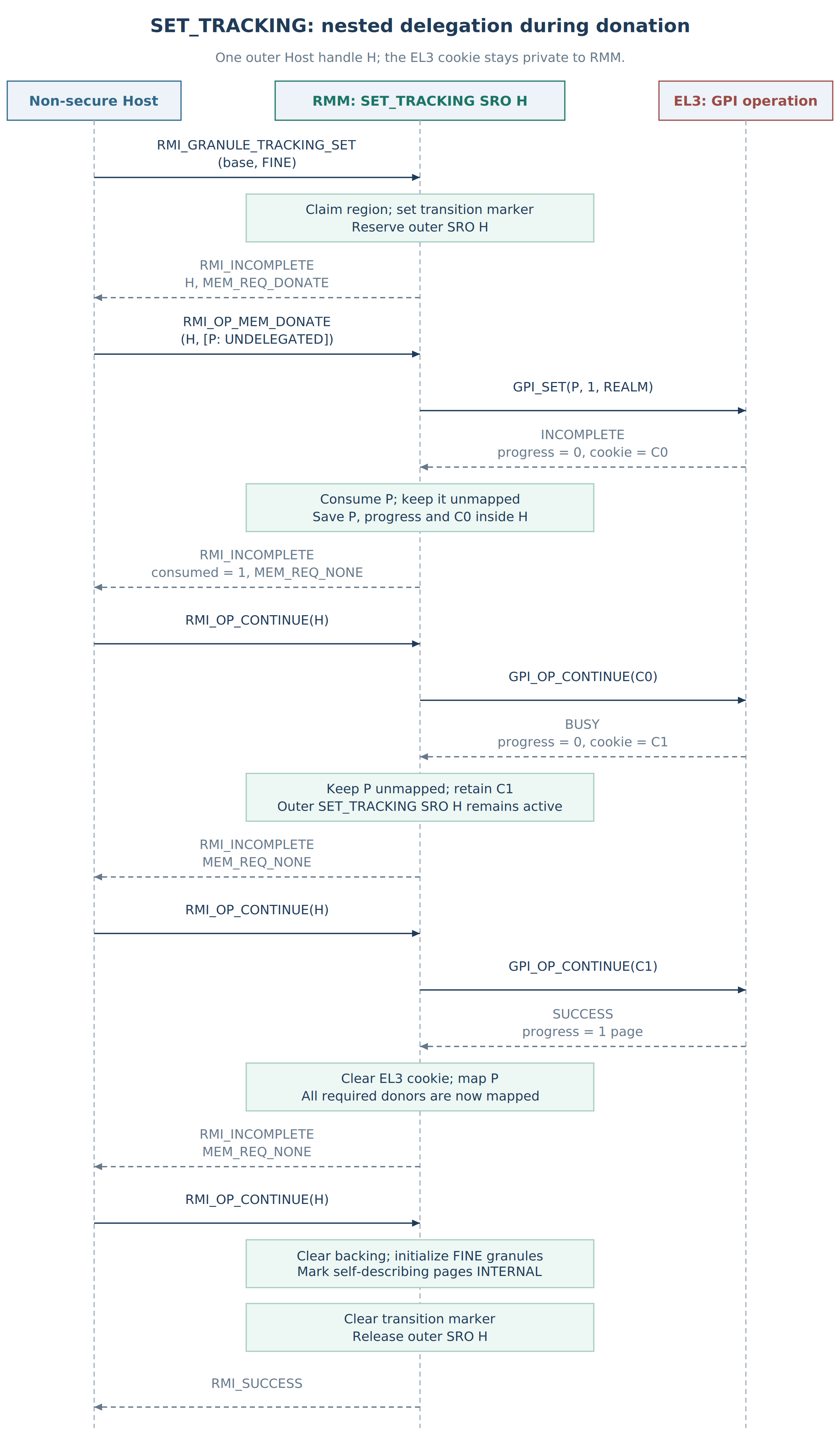
Donation into FINE tracking. P is the last required self-describing
page and starts as UNDELEGATED in a NONE or NS COARSE region.
All RMM-to-EL3 arrows use the shared GPI helper. C1 denotes the cookie
returned with BUSY; it may equal C0.
In the donation example:
EL3 returns
INCOMPLETEforP. RMM acceptsPfrom the donation list but leaves it unmapped until its PAS change finishes. The Host must not donate it again; any later pages in that list remain with the Host.The Host calls
RMI_OP_CONTINUE(H). RMM usesCto resume EL3’s work. More than one continuation may be needed.Once EL3 finishes, RMM maps
P. It asks for any remaining donors or, as shown, a final continuation to initialize the fine representation.That final continuation publishes
FINE, clears the pending marker and releasesH.
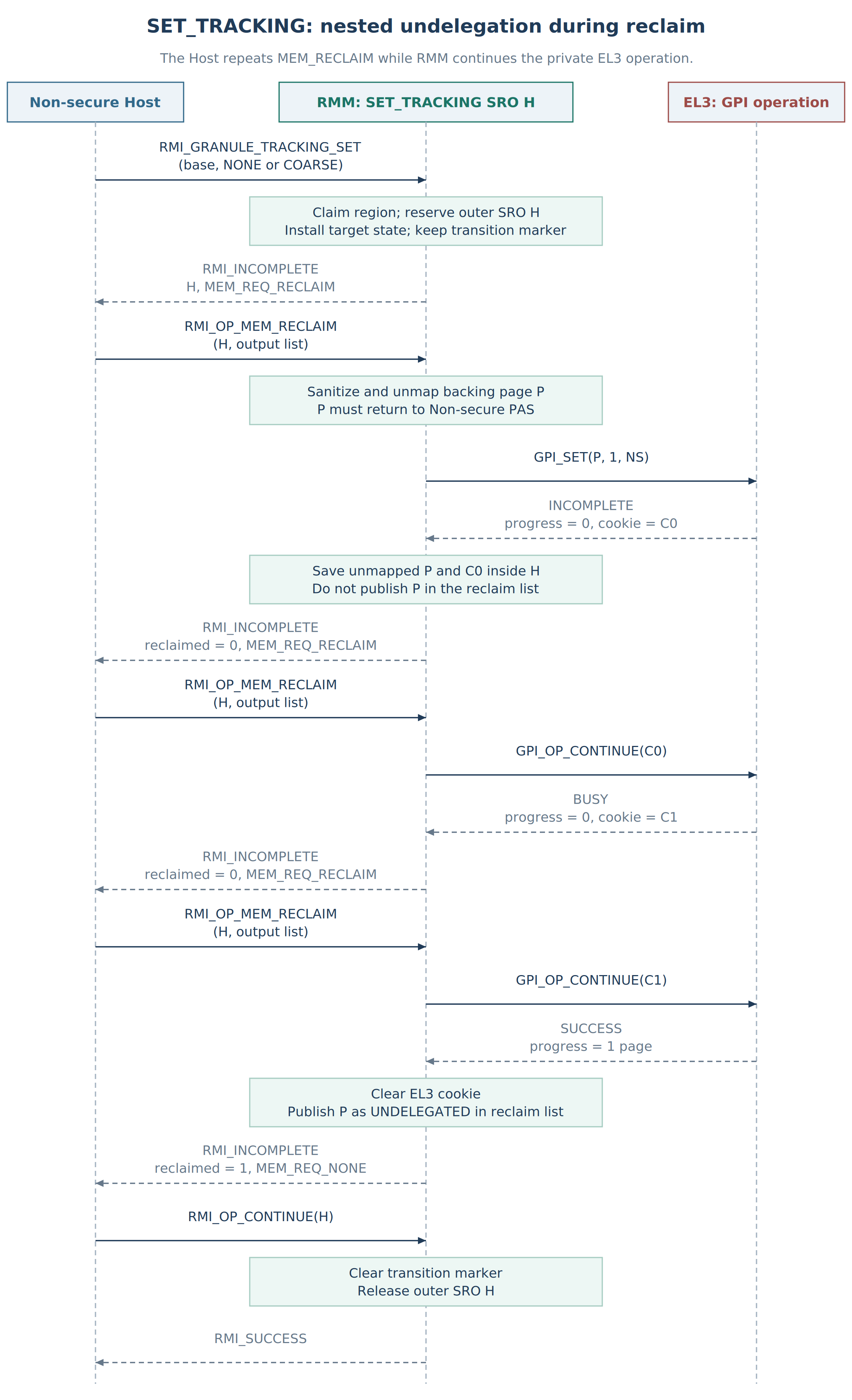
Reclaim after leaving FINE for NONE or NS COARSE. P is the
last self-describing backing page and must return to Non-secure PAS.
Previously completed pages may already have been returned to the Host.
All RMM-to-EL3 arrows use the shared GPI helper.
During reclaim, the Host follows MEM_REQ_RECLAIM and repeats
RMI_OP_MEM_RECLAIM(H, ...). Internally, RMM may use those calls to
resume EL3 with GPI_OP_CONTINUE(C). A page awaiting EL3 completion stays
unmapped and out of the reclaim list. Pages already returned remain complete.
Once every page has been returned, MEM_REQ_NONE tells the Host to make
the final RMI_OP_CONTINUE(H). That clears the marker and releases the SRO.
For the shared EL3 cookie and continuation rules, see Delegation progress and retry policy. SET_TRACKING handles page ownership and cleanup as follows:
Initial donor delegation returning
BUSYmakes no progress and retains no cookie. The donor remains unconsumed with the Host, which may resubmit it throughRMI_OP_MEM_DONATE.Reclaim returning
BUSYwithout a retained EL3 operation leaves the page in Realm PAS. RMM restores its mapping and withholds it from the reclaim list until a retry succeeds.Donation encountering
OP_CONFLICTdiscards the EL3 cookie and starts reclaim of all accepted donors. An unaccepted donor remains with the Host; an accepted donor that has not been delegated is returned untouched, without mapping or sanitization. Earlier delegated donors are reclaimed through the normal cleanup path. The transition marker remains set until cleanup finishes. The finalRMI_OP_CONTINUEclears the marker, releasesHand returnsRMI_BLOCKED. If no donor was accepted, there is no reclaim step.Permanent delegation failure after accepting a donor returns that donor untouched in Non-secure PAS, without mapping or sanitizing it. RMM also reclaims earlier accepted backing and keeps the transition marker until all accepted pages have been returned through
RMI_OP_MEM_RECLAIM. A finalRMI_OP_CONTINUEreturnsRMI_ERROR_INPUTand releasesH.
3.2.4. Tracking transitions
Changing the tracking mode must preserve the state of the memory it describes. Splitting one granule into many is possible for more states than merging many granules into one.
For example, with metadata supplied from outside a homogeneous 2 MiB region:
Splitting a coarse
DELEGATEDgranule creates 512 fineDELEGATEDgranules.Merging 512 fine
DELEGATEDgranules creates one coarseDELEGATEDgranule.Merging 511
DELEGATEDgranules and oneNSgranule is rejected: a single granule cannot record both states.Even 512
DATAgranules cannot currently be merged. The implementation only allows fine-to-coarse conversion forNSorDELEGATEDmemory.
The full rules are below. An ordinary granule means one that does not
describe a self-describing metadata page. Those metadata pages are locked
in INTERNAL state and handled separately during reclaim. At least one
ordinary granule must exist when leaving FINE. Every transition to
COARSE also requires a homogeneous region.
Transition |
Required Granule state |
Metadata action in SRO mode |
|---|---|---|
|
New granules are initialized as |
Donate the target region’s fine pages. |
|
The new coarse granule is initialized as |
None; the region must be homogeneous. |
|
Every ordinary granule must have the same |
Reclaim the fine pages after publishing |
|
Every ordinary granule must be |
Reclaim the fine pages after publishing |
|
Conventional: |
Donate the target region’s fine pages. |
|
The coarse granule must be |
None. |
Splitting coarse DATA or MAPPED copies its reference count to each
fine granule. For example, if the coarse count is 2, every new fine count
is also 2: each page still has the same auxiliary mapping references. The
count is not divided among the pages. Objects such as RD and RTT
always need fine tracking and cannot use this split path.
Requesting the state already installed succeeds without changing anything,
unless a tracking SRO owns the region. INTERMEDIATE tracking is not
currently supported.
3.3. Runtime management
3.3.1. Lookup and locking
Two locks protect different things:
The region’s reader-writer lock protects the choice of active granules.
A Granule lock protects a selected granule’s state and use.
Runtime callers use tracking-aware lookup helpers to make the handover between these locks safely. A regular lookup does the following:
Find the
struct tracking_memory_bankandstruct tracking_regionfor the input PA.Acquire the tracking-region read lock.
Verify that the active tracking state supplies the requested granularity.
Select the active coarse or fine granule.
Acquire the selected Granule lock and verify its expected state.
Release the tracking-region read lock.
The read lock keeps the chosen representation active until the caller has locked its granule. The granule lock then keeps it active for as long as the caller needs it. An unlocked granule pointer alone provides no such protection: its metadata could be reclaimed by a later transition.
For example, suppose all fine granules are NS. CPU A locks F7
and releases the region read lock. CPU B then tries to make the region coarse.
B can take the region write lock, but it cannot lock F7. B must release
all locks it acquired for this attempt and return RMI_BUSY. A can finish
using F7, and B can retry.
A transition never waits for another caller while holding the region writer:
Try the region write lock. If a reader is active, back off.
Try the active source granule locks. A coarse source needs one lock. A fine source locks
granulesfirst, thendev_granules, with each group in ascending PA order. Check the allowed states as each lock is acquired; ordinary fine granules must all have the same state.If any lock is busy, release the source locks already acquired and the region writer, then return
RMI_BUSY.Otherwise, initialize the inactive destination and publish the new state. Release the source locks, then the region write lock.
Backing off also lets an ordinary caller perform another lookup while holding an earlier granule lock. Multi-Granule callers must still acquire granules in the order specified by RMM Locking Guidelines. Each lookup manages its own short-lived region read lock.
A tracking SRO performs the same source locking and validation before setting
its pending marker. A busy lock or invalid state leaves the marker clear.
Once set, the marker blocks new ordinary lookups during metadata transfer.
Before publishing the new state, the SRO reacquires the region write lock and
any active source-granule locks. Once all required metadata pages have been
donated, lock contention during this step preserves the donated pages and
pending marker, and returns RMI_INCOMPLETE with MEM_REQ_NONE. The Host
retries through RMI_OP_CONTINUE.
Following the lock order and backing off avoids deadlock. It does not guarantee fairness: continuous reader or granule activity can keep delaying a transition.
3.3.2. SRO context reservation
RMM has a finite pool of SRO contexts. Where possible, it validates the request and selects the work before reserving one. For example, a request to set an already-installed tracking state needs no context. Invalid input, incompatible tracking and ineligible Granule states can also be rejected first.
A context must be reserved before work that might need to continue in another
RMI call. In particular, RMM needs somewhere to save an EL3 cookie before
issuing a request that can return INCOMPLETE. On completion or failure it
releases the context. Before yielding, it saves the progress and seals the
context so the Host can resume it using the returned handle.
3.3.3. Single and range operations
Single-Granule RMI commands require fine tracking. If the address belongs
to a coarse, NONE or RESERVED region, the lookup cannot return such an
object and reports RMI_ERROR_TRACKING.
Range commands ask for the active tracking size: how many bytes the selected granule covers. That is 4 KiB for fine tracking, or the whole configured region size for coarse tracking. The caller advances in those units and checks that each unit:
begins at an address aligned to the active tracking size; and
fits completely within the remaining command range.
For example, a coarse region at 0x80000000 can be delegated as a whole
2 MiB unit. A request for only its first 4 KiB cannot use that granule and
fails with RMI_ERROR_TRACKING. After switching the region to FINE,
that 4 KiB request can use its own granule, subject to the normal state
checks.
A lookup failure caused by an unavailable or incompatible representation is
returned as encoded RMI_ERROR_TRACKING. The current implementation reports
tracking error level zero and includes the first failing PA. Invalid addresses,
categories or object states instead return the command-appropriate input or
state error.
A region with a pending tracking SRO returns RMI_BLOCKED, without
tracking-error level or PA fields. The Host must finish that SRO before
retrying. A busy transition lock instead returns RMI_BUSY and can be
retried. These results describe different causes:
Result |
Example cause |
What allows progress |
|---|---|---|
|
A 4 KiB request encounters a coarse granule covering 2 MiB. |
Use compatible tracking and range sizes. |
|
SET_TRACKING is still waiting for metadata donation. |
Complete the owning tracking SRO, then retry. |
|
A transition cannot acquire a granule lock. |
Retry after the current lock holder can finish. |
The RMI_BLOCKED behavior follows RMM v2.0 Beta 3 section B4.3.3,
rule RBPKWX for access to an object left in an intermediate state.
3.3.3.1. Skipping memory already in the target state
Delegation skips memory that is already DELEGATED. Undelegation skips
memory that is already NS. The skip counts as successful progress and
needs no SRO context or EL3 call, although tracking and range checks still
apply. This follows RMM v2.0 Beta 3 section A2.3.6.2, rule IRZJLF.
In-use states such as DATA, RD and REC cannot be skipped. At the
initial address they cause RMI_ERROR_INPUT. If the command has already
processed some memory, it returns that progress and leaves the failing
address for the Host’s next invocation.
Throughout this guide, a prefix is the consecutive part of a range already
processed, starting at its base. The suffix is the part still to do.
out_top is the first address after the processed prefix.
Range delegation first skips any leading DELEGATED granules, then
collects consecutive NS granules. It stops before the next
already-delegated granule, so EL3 receives only memory that needs a PAS
change. One RMI invocation issues at most one FIRME request and returns the
address after the processed prefix.
For example, consider ten fine-tracked Granules G1 through G10, with
G5, G6 and G9 already DELEGATED. With FIRME completing each
submitted range, delegation proceeds as follows:
Starting at
G1, RMM collectsG1throughG4and stops beforeG5. It asks EL3 to delegate that four-Granule range and returnsG5as the next address.The Host reinvokes the command at
G5. RMM skipsG5andG6, asks EL3 to delegateG7andG8, and returnsG9.The Host reinvokes the command at
G9. RMM skipsG9, asks EL3 to delegateG10, and returns the end of the requested range.
The sequence therefore uses three RMI invocations and three EL3 delegation calls. An EL3 partial response can require additional Host invocations because only the processed prefix is reported as progress.
The same rule applies in a larger region. Consider a fine-tracked 1 GiB region, fully covered by conventional memory, with just one Granule already delegated at its midpoint:
B = 0x40000000is the region base.M = 0x60000000is the midpoint, 512 MiB afterB.N = 0x60001000is one Granule afterM.T = 0x80000000is the region’s exclusive top, 1 GiB afterB.
The notation [B, M) includes B and stops just before M.
Assuming EL3 completes each request:
The first invocation delegates
[B, M)and returnsRMI_SUCCESSwithout_top = M.The Host calls
RMI_GRANULE_RANGE_DELEGATE(M, T). RMM skips the already-delegated[M, N), delegates[N, T)and returnsout_top = T.
The skipped Granule is excluded from both EL3 requests. These are two
successful range calls; the Host starts the second at out_top rather
than using RMI_OP_CONTINUE. The skip does not cause a tracking error.
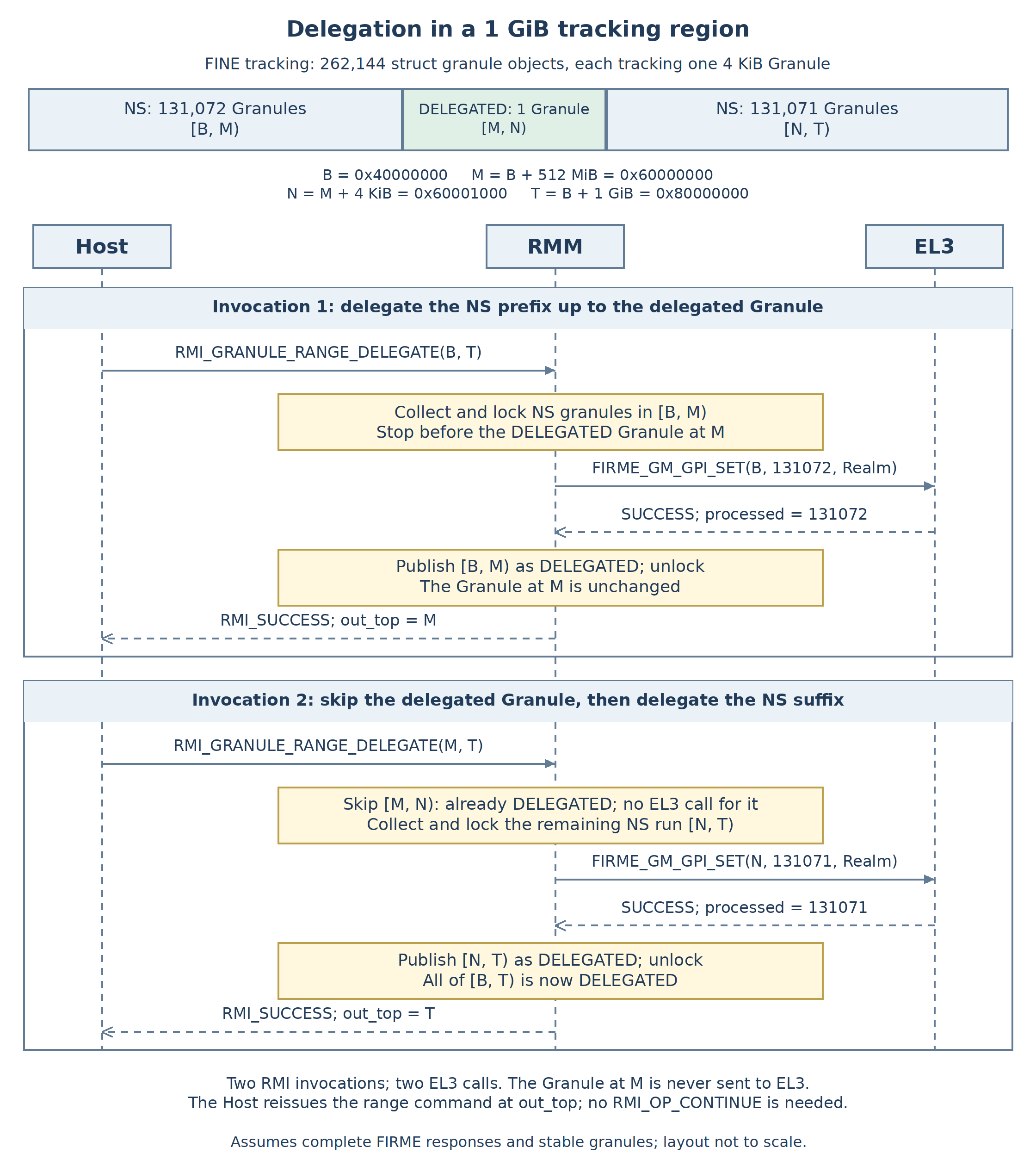
Delegation across an already-delegated 4 KiB Granule in a 1 GiB tracking region. FIRME completes the first request for 131,072 Granules and the second for 131,071 Granules. Together with the skipped Granule, these cover all 262,144 Granules in the region. Partial FIRME responses can require additional invocations. The memory layout is not drawn to scale.
With COARSE tracking, the same 1 GiB region has a single granule and
cannot represent an individual delegated Granule between NS runs. An
already-DELEGATED coarse region is skipped as one complete tracking unit;
an NS coarse region is delegated as a whole. A partially completed coarse
transition remains PARTIAL until continuation or rollback resolves it, as
described below.
3.3.3.2. Undelegating a range
Range undelegation skips leading NS granules, then processes consecutive
DELEGATED granules in the current region. Fine tracking can batch many
4 KiB pages; coarse tracking processes one whole 2 MiB or 1 GiB unit.
A fine batch stops at the requested top, a memory-bank or region boundary,
or a change in state or device coherency type.
Before contacting EL3, RMM prepares the batch:
Reserve an SRO context. If this fails, unlock the granules and leave them
DELEGATED.Change the locked granules to
PARTIAL, then release their locks. This state records that the SRO owns work that is not yet complete.Sanitize the whole conventional-memory batch, overwriting its old contents before EL3 changes any page’s PAS. Device memory is not sanitized. If an interrupt pauses this work, save the batch and next page offset for
RMI_OP_CONTINUE.
Continuation finishes sanitizing the original batch before its first EL3 request. Keeping the selected range together lets EL3 optimize range processing.
After each EL3 call, completed fine pages become NS. If EL3 retains a
cookie, the SRO still owns the remaining PARTIAL pages. Once the EL3
operation ends, RMM returns any completed prefix as RMI_SUCCESS with
out_top and restores untouched pages to DELEGATED for a new request.
Skipped leading NS pages count as progress. RMM owns the pages being
undelegated, so an EL3 conflict or rejection violates the ownership contract.
The EL3 adapter asserts this contract for initial requests and continuations,
including metadata reclaim and delegation rollback.
For example, if EL3 finishes the first 3 pages of an 8-page fine batch and
retains no cookie, those 3 stay NS. The other 5 return to DELEGATED,
and out_top points to page 4. A coarse granule cannot record this mix:
it becomes NS only when its entire region has reached Non-secure PAS.
With no progress, an initial fine BUSY returns RMI_BUSY. An existing
SRO instead yields and retries.
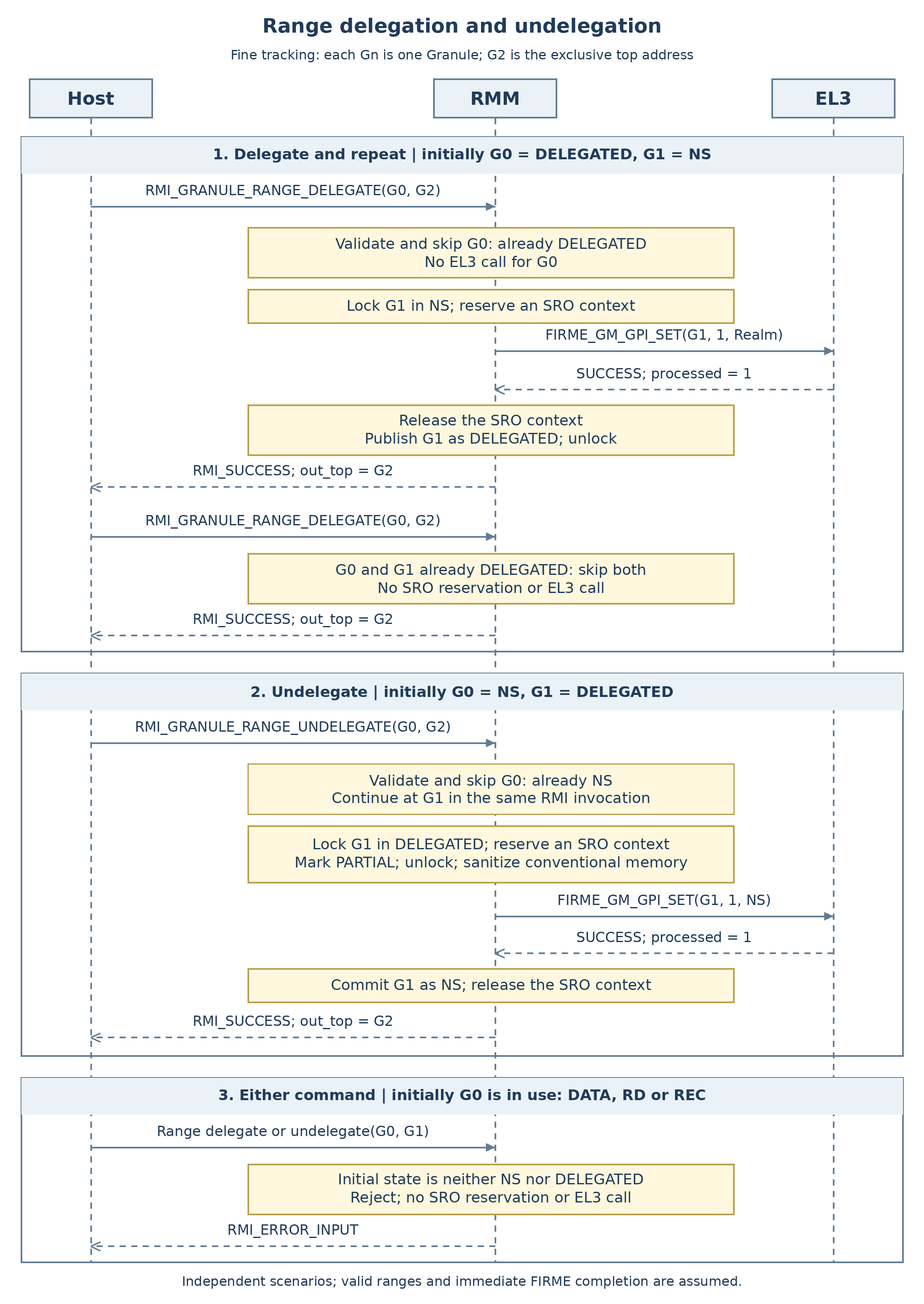
Target-state handling for range delegation and undelegation. Each Gn is
one fine-tracked conventional Granule; G2 is the exclusive top address.
The three scenarios are independent and assume valid ranges and immediate
FIRME completion. A repeated delegation needs no EL3 call once every
granule is DELEGATED. Undelegation skips an already-NS prefix
and processes the following DELEGATED run in the same invocation. Device
and coarse granules use the same target-state checks at their active
tracking size.
The legacy GTSI interface processes the selected range one Granule at a time. Each undelegation call requires a page that RMM owns in Realm PAS. Delegation rollback therefore undelegates only the prefix that EL3 successfully delegated. Metadata reclaim invokes EL3 only when a backing page must move from Realm PAS to Non-secure PAS. A failed donor already in Non-secure PAS is returned without an EL3 call.
RMM Granule states record software ownership and operation progress separately
from the hardware PAS. Pages can therefore be in Realm PAS while their granules
are PARTIAL or INTERNAL.
3.3.3.3. Delegation progress and retry policy
EL3 may finish only part of a delegation request. Fine granules can record that progress page by page. A coarse granule must eventually describe one state for the whole region, so partial completion needs more work.
Both delegation and undelegation send EL3 as much of the Host’s range as the
current region, memory banks, Granule states and device coherency allow.
An invocation stays within one region; the Host starts a new request at
out_top to move into the next one.
To decide what happens next, the RMI layer needs three separate facts from the EL3 adapter:
Result: did the call succeed, encounter contention or fail?
Progress: how much of the requested range did this call process?
Continuation: does EL3 still have an operation to resume with a cookie?
For example, an error can arrive with valid progress. The adapter preserves both facts; the RMI layer decides whether to return the progress, retry or roll back. The legacy GTSI fallback likewise preserves both its completed prefix and the first rejected Granule’s error. The rules below use total progress, including previous continuations and skipped leading Granules.
An outstanding EL3 operation must be handled first:
INCOMPLETEretains a stateful operation. RMM records the returned cookie and any new progress, then yieldsRMI_INCOMPLETEwith an SRO handle.BUSYfromFIRME_GM_GPI_OP_CONTINUEmeans EL3 could not act on that invocation of the existing operation. It adds zero progress; itsUNKNOWNcount is ignored. RMM keeps the accumulated prefix, records the returned cookie for that operation, and yields again. The returned cookie is used even if it equals the previously supplied cookie.These rules apply to both fine and coarse tracking. Fine progress cannot complete the RMI SRO while EL3 still retains the outstanding operation.
Once EL3 has no operation to resume, the result is stateless. RMM may still need its own SRO to finish the range. Its next action depends on total progress and tracking size:
EL3 result |
Coarse tracking with a partial region |
Fine tracking with a completed prefix |
|---|---|---|
|
Keep the prefix and retry the suffix until the region is complete. |
Return |
|
Treat as temporary contention. Keep the prefix and retry the suffix. |
Return |
|
Roll back the accumulated delegated prefix to Non-secure PAS before
returning |
Return |
Permanent error, such as |
Roll back the accumulated delegated prefix to Non-secure PAS before
returning |
Return |
A completed coarse region returns RMI_SUCCESS. With no accumulated progress,
OP_CONFLICT returns RMI_BLOCKED without rollback, for both an initial
request and a continuation. Restore any owned PARTIAL granules to NS
and release the SRO before returning. An initial stateless BUSY returns
RMI_BUSY; an existing SRO yields and retries it. A permanent failure without
progress returns RMI_ERROR_INPUT. SUCCESS without progress in the
individual EL3 call violates the FIRME result contract: RMM logs an ERROR
and calls panic(), including when assertions are disabled.
Each RMI invocation issues at most one FIRME request, then yields if more
work is needed. Without an EL3 cookie, the next RMI_OP_CONTINUE starts a
fresh FIRME_GM_GPI_SET for the remaining suffix. With a cookie, it uses
FIRME_GM_GPI_OP_CONTINUE. A delegation OP_CONFLICT invalidates the cookie,
including on continuation. Coarse rollback therefore starts a fresh GPI_SET
to return the accumulated prefix to NS. Keep the granule PARTIAL and
return RMI_INCOMPLETE while rollback runs. Save the terminal RMI_BLOCKED
status across its partial progress, BUSY responses and cookie changes.
For example, start with a coarse 2 MiB region in NS state. Assume each
EL3 response below is stateless:
Host call |
EL3 response |
RMM action |
|---|---|---|
Range delegation |
|
Keep 64 KiB of progress; yield |
|
|
Keep the same 64 KiB; yield again with |
|
|
Set the coarse granule to |
If the last EL3 call instead reports DENIED after another 4 KiB, RMM
must undo all 68 KiB of delegation. Only after rollback finishes does it
return RMI_ERROR_TRACKING.
If it reports OP_CONFLICT after another 4 KiB, the same 68 KiB rollback is
required, but the terminal result is RMI_BLOCKED. This also applies when
the initial delegation request encounters a conflict after partial progress.
For a fine-tracked request, the first stateless 64 KiB prefix can immediately
return as RMI_SUCCESS: its 16 granules can each record DELEGATED.
This also holds if the response includes a conflict or permanent error. The
completed prefix is kept, and the Host can make a new request for the suffix.
PARTIAL granules block SET_TRACKING with RMI_BLOCKED without starting
a tracking SRO. A fine delegation that yields before making progress reserves
its entire selected run as PARTIAL. As fine pages are delegated, their states
become DELEGATED; any unfinished suffix returns to NS when the SRO ends.
Granule locks are released before yielding; the SRO remains non-cancellable.
3.3.4. Tracking RMI commands
RMI_GRANULE_TRACKING_GET queries a PA range [base, top) with
Granule-aligned endpoints. It reports the memory category and tracking state
at base, and where either attribute first changes, stopping at top.
It can combine adjacent banks in one result when both attributes match.
A hole reports category NONE and state RESERVED.
For example, using the bank layout above, suppose bank A is coarse tracked.
A query from 0x80000000 to 0x80600000 first reports conventional,
COARSE, ending at 0x80200000. A new query starting there reports
the hole as NONE, RESERVED, ending at 0x80400000. The Host can
walk a large range by starting each query where the previous result ended.
RMI_GRANULE_TRACKING_SET changes one region, identified by its aligned
base. If that base belongs to a bank, the request must give the bank’s exact
RMI category. A base in a hole is accepted only when valid memory exists at a
higher physical address within the same region. That region is diverse and can
be NONE or FINE; the supplied category cannot make it eligible for
COARSE tracking.
SET validates the transition. Requesting the already-installed state succeeds
unless a tracking SRO still owns the region. While that SRO is donating or
reclaiming metadata, any second SET returns RMI_BLOCKED, even if it asks
for the same state. The Host must finish the owning SRO first.
Invalid alignment, category, target state or source-state transition returns
RMI_ERROR_INPUT. RESERVED and INTERMEDIATE are not accepted as SET
targets by the current implementation.
3.4. RTT map and unmap interaction
3.4.1. Tracking size and S2TT level
DATA and DEV map/unmap commands connect two views of memory. Stage 2 translation table (S2TT) entries describe Realm mappings. Tracking granules record the state of the physical memory behind those mappings. The two views can use different sizes, subject to this rule:
active tracking size <= S2TT mapping size <= tracking-region size
The S2TT walk level selects the mapping size. With the current 4 KiB Granules, level 3 maps a 4 KiB page, level 2 a 2 MiB block and level 1 a 1 GiB block. The size rule applies to each S2TT entry. A Host request can cover multiple entries and tracking regions.
Region size |
Tracking mode |
Requested mapping |
Size check |
|---|---|---|---|
2 MiB |
|
4 KiB page |
Fails: the granule covers more than the mapping. |
2 MiB |
|
2 MiB block |
Passes: 512 granules cover the block. |
2 MiB |
|
1 GiB range using 2 MiB blocks |
Passes: each block fits within one region. |
1 GiB |
|
1 GiB block |
Passes: fine tracking can support a large mapping. |
Passing this size check is only part of validation. The backing PA must be
aligned to the active tracking size, and each tracking unit must fit in the
unprocessed part of the block. Block alignment and the size rule keep a block
inside one region. A single S2TT block larger than the configured region returns
RMI_ERROR_TRACKING.
DATA_UNMAP and DEV_UNMAP return their completed prefix before entering
another physical tracking region. For a 1 GiB range using 2 MiB blocks backed by
contiguous 2 MiB tracking regions, completing the first block returns
RMI_SUCCESS with out_top advanced by 2 MiB. The Host reinvokes the command
at out_top to process the remaining range.
DATA_MAP and DEV_MAP can complete blocks from multiple tracking regions
in one invocation. Each block completes before the next starts.
Map and unmap hold granule locks while processing memory, except that coarse
DATA_MAP owns its PARTIAL unit while zeroing and coarse unmap owns its
PARTIAL unit through invalidation and drain.
A locked granule prevents a transition claim. Fine DATA and MAPPED
states and coarse PARTIAL ownership also prevent claims across yields.
See RMM Locking Guidelines for the full protocol.
3.4.2. Map
Mapping prepares the backing memory before making the translation usable. DATA and DEV map first mark the target S2TT entry (S2TTE) as drain pending. Here, a drain is the deferred work that brings each backing granule to its required state. The SRO processes one active granule at a time:
DATA locks a
struct granuleinDELEGATEDstate. With fine tracking, it zeroes the page under the Realm’s Memory Encryption Context (MEC) and changes its state toDATA. With coarse tracking, it claims the whole unit asPARTIALand releases its lock before zeroing pages. The unit becomesDATAonly when every page has been zeroed.DEV locks a
dev_granuleinDELEGATEDstate and changes its state toMAPPED. Every tracking unit in one S2TT block must have the same device coherency type.
For example, mapping a fine-tracked 2 MiB conventional block processes 512 fine
granules. Each page is zeroed and changed from DELEGATED to DATA.
Only after all 512 are ready does RMM publish the assigned S2TTE.
A lookup failure, size mismatch or coherency mismatch triggers rollback:
return processed granules to DELEGATED, clear the
pending S2TTE marker, drop the leaf RTT reference and report the original
error. A tracking mismatch includes the failing PA in RMI_ERROR_TRACKING.
3.4.2.1. Tracking stability during a map SRO
DATA_MAP and DEV_MAP retain an SRO only after making progress in the current
block. An IRQ before the first page is processed does not pause the drain.
Once a fine granule becomes DATA or MAPPED, that prefix prevents
tracking transitions for the entire region, including publication of a pending
transition marker. The drain can then yield between fine granules. Rollback
has the same protection until it releases the last processed granule; it then
clears the S2TTE marker and finishes without another yield or lookup.
A valid coarse mapping covers exactly one tracking region. DATA_MAP reserves
its coarse struct granule in PARTIAL state and saves a page offset in
the SRO. Zeroing can yield on an interrupt after each page except the last;
each continuation processes at least one more page before yielding. PARTIAL
prevents a tracking transition from replacing the coarse representation or
another operation from reusing the unzeroed suffix. The SRO retains ownership
without holding the granule lock. Once the whole region is zeroed, it changes
the state to DATA and finalizes the S2TTE without another yield or fallible
operation. The zeroing offset is internal progress: no fraction of the coarse
unit can be reported as a successful mapping. Errors before ownership is
claimed leave the unit unchanged; after the claim, zeroing can only yield or
complete, so it never enters fine-granule rollback.
Coarse DEV_MAP completes its single state change without yielding. An L3 page mapping also completes after its single fine granule is processed.
A tracking transition can race with map before its first granule is locked.
If it completes first, the lookup discovers the current tracking size. If it
is still pending, the lookup returns RMI_BLOCKED. Map clears its unused
S2TTE marker and drops the leaf reference without retaining an SRO. The Host
can complete the tracking operation and retry the map. If earlier blocks in
the call already completed, map returns success for that prefix instead.
Those completed blocks are not rolled back.
Across a map yield, the leaf reference keeps the RTT hierarchy and RD alive.
The fine DATA or MAPPED prefix, or coarse PARTIAL ownership, keeps
tracking stable. No granule lock or tracking-region reader is held across the
return to the Host.
3.4.3. Unmap
Unmap checks the backing memory before making a live translation unavailable.
Every DATA granule must be DATA; every DEV dev_granule must be
MAPPED. The size and alignment rules are the same as for map. Unmap also
checks that no auxiliary RTT references remain. Only then does it mark the
S2TTE for deferred work.
The tracking mode determines how long validation must keep a granule locked:
With fine tracking,
DATAandMAPPEDstates already prevent a tracking transition from being accepted. Unmap can release each granule lock after checking it.With coarse tracking, those states still allow a split to fine. Validation retains the lock until the block is queued and its S2TTE is marked pending. Unmap then changes the coarse
struct granuleorstruct dev_granuletoPARTIALand releases its lock. The SRO owns the whole unit through invalidation and drain. A split attempt returnsRMI_BLOCKEDwithout setting a tracking marker. Continuation uses the owned object directly.
For example, a coarse 2 MiB DATA block uses one struct granule. The SRO
keeps it PARTIAL while completing invalidation, including an outstanding
SMMU CMD_SYNC. After invalidation, cache maintenance processes its 512 pages
with IRQ checks between pages. Each drain continuation processes at least
one page, and saves its position if it yields. The whole unit remains
PARTIAL, including the maintained prefix. After the last page it becomes
DELEGATED and the pending S2TTE marker is cleared without another yield.
DATA_UNMAP and DEV_UNMAP queue only one coarse block before draining. Neither holds one backing-granule lock while acquiring another, and neither retains an outer tracking-region read lock.
After scanning the selected mappings and performing the required TLB
invalidations, unmap processes the output PAs in ascending order. DATA performs
the required cache maintenance and returns granules to DELEGATED;
DEV changes fine MAPPED granules or its coarse PARTIAL unit to
DELEGATED. Fine drains advance one granule at a time. Coarse DATA saves
page-level cache-maintenance progress but publishes only the whole region.
Once invalidation completes, the SRO records its completion. Subsequent
continuations resume the remaining drain work without repeating the
invalidation phase.
UNPROT mappings do not own tracked backing Granules. Their map and unmap flows
therefore do not change granule or dev_granule states.
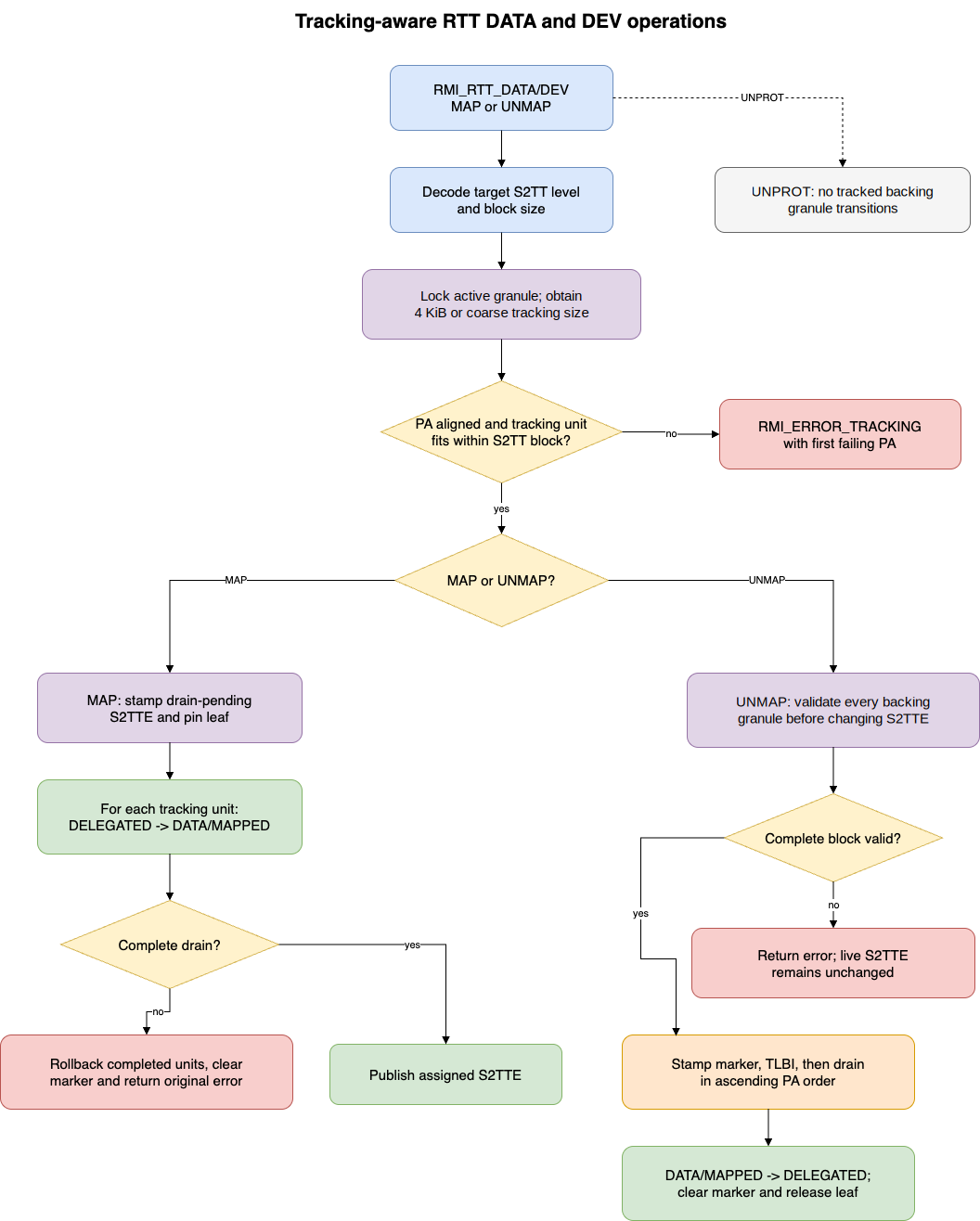
Tracking validation and state changes around DATA and DEV RTT operations.
For the common range command, drain-marker, yield and result-formatting design, see RTT map/unmap flows.
3.5. Current implementation limits
Only 4 KiB RMI Granules are supported.
INTERMEDIATEtracking is not implemented.